
Disclosure: This page may contain affiliate links. I may earn a commission at no extra cost to you if you purchase through one of these links.
Creating a long, useful eBook can feel overwhelming when you are starting with a blank page. You need to choose a focused topic, organize your ideas, draft multiple chapters, edit the content, and prepare the final document for readers. Ai Long eBook Creator is intended for people who want AI assistance with this process, but it is important to understand what a tool like this can and cannot do before relying on it.
This guide takes a practical look at Ai Long eBook Creator for beginners, affiliate marketers, and small online business owners. You will learn how to evaluate the product, where AI may fit into your workflow, and how to turn an initial draft into an eBook that is accurate, original, and genuinely helpful.
Affiliate disclosure: This article contains an affiliate link. If you purchase through it, the publisher of this article may receive a commission at no additional cost to you. This does not affect the points you should consider before buying. TubeBook AI Review: A Practical Guide for Turning Video Content Into Digital Books
What Is Ai Long eBook Creator?
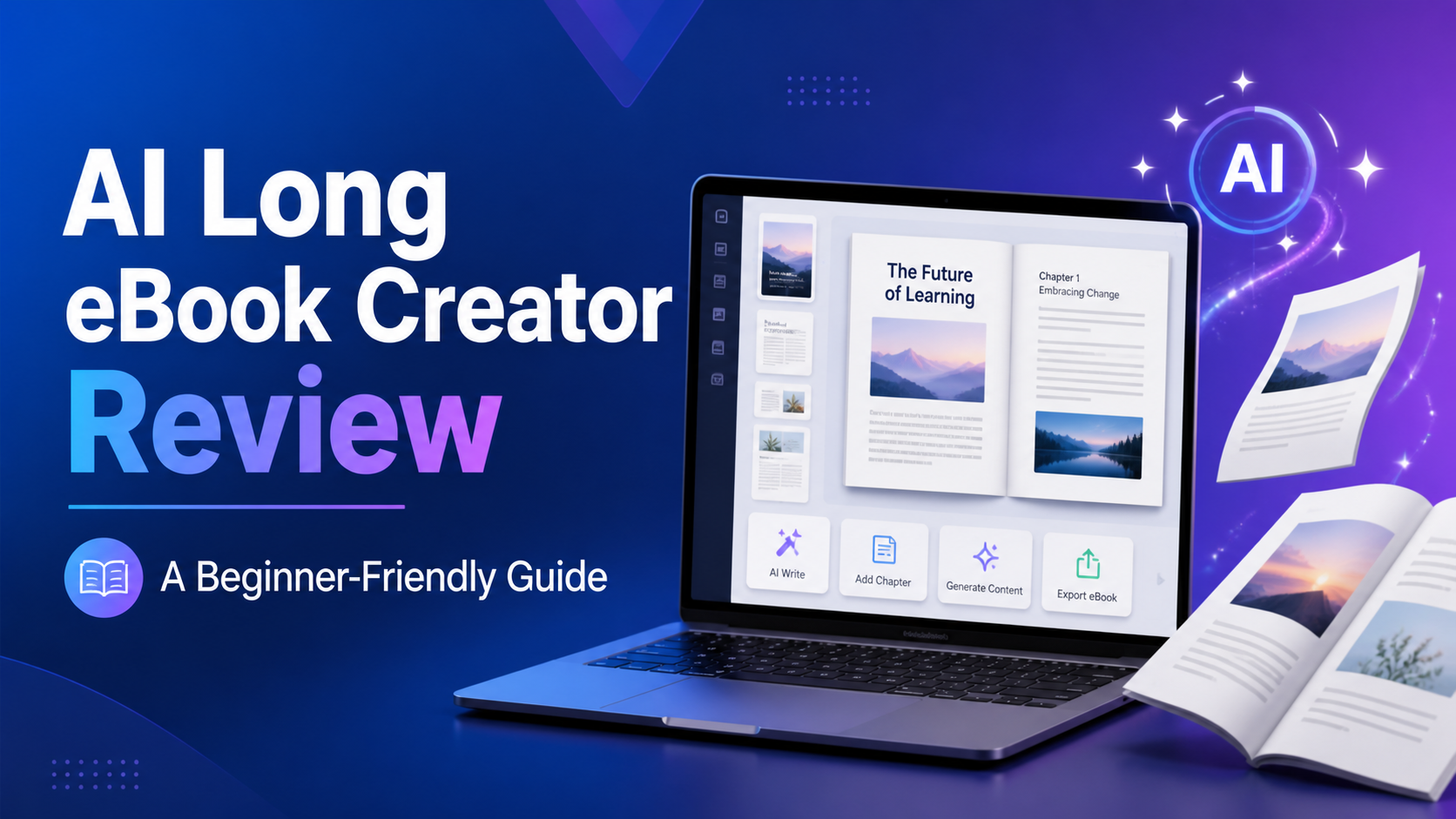
Ai Long eBook Creator is presented as a tool for helping users create longer eBook content with artificial intelligence. Its main appeal is straightforward: instead of drafting every section manually, you may be able to use AI-generated material as a starting point for outlines, chapters, explanations, and other parts of an eBook.
That does not mean the software should replace your judgment. AI-generated writing can be repetitive, vague, inaccurate, or too similar to common material found online. A responsible creator still needs to review every chapter, verify factual claims, add original insights, and make sure the finished book matches the needs of its intended audience.
Product features, pricing, usage limits, commercial rights, and refund terms can change. Review the current information on the official sales page rather than assuming that every feature mentioned in older reviews is still available.
Who Might Find It Useful?
Ai Long eBook Creator may be worth exploring if you already have a useful topic but find it difficult to organize or expand your ideas. It could also appeal to business owners who want to create educational resources without spending all their time on a first draft.
Beginners creating their first eBook
A beginner may benefit from help developing a logical structure. For example, someone creating a guide to home organization could begin with chapters covering goal setting, decluttering, storage, daily routines, and long-term maintenance. AI can suggest a starting outline, while the creator decides what deserves to remain.
Small business owners educating customers
A service provider might create a short educational book that answers common customer questions. A freelance web designer, for instance, could publish a guide explaining how small businesses should prepare content before a website project. The eBook could be offered as a lead magnet, customer resource, or low-cost product.
Affiliate marketers building supporting content
Affiliate marketers can use eBooks to explain a problem in more depth than a single blog post allows. However, the book should not be a collection of sales pitches. It should help readers understand the topic, compare possible approaches, and make their own decisions. Any affiliate relationship should be disclosed clearly.
Coaches, consultants, and course creators
People with existing frameworks may use AI assistance to turn notes, lessons, or presentation material into a structured draft. The value still comes from the creator’s real knowledge. AI should help organize that knowledge rather than pretend to supply expertise that the creator does not have.
Potential Benefits of an AI-Assisted eBook Workflow
Getting past the blank page
One of the hardest stages of writing is deciding where to begin. AI can provide possible titles, reader questions, chapter ideas, and section headings. Even when the first suggestions are not suitable, they may help you identify a better direction.
Creating a more complete outline
A clear outline reduces the chance of jumping between unrelated ideas. It can also reveal missing steps. If your book teaches readers how to start an email newsletter, the outline should address topics such as audience selection, signup incentives, content planning, sending frequency, and basic performance review.
Speeding up early drafts
AI-generated text may reduce the time required to produce a rough draft. This is most useful when you treat the output as editable material rather than a finished product. Time saved during drafting can then be used for research, examples, design, and quality control.
Exploring different explanations
If a section feels confusing, AI may suggest a simpler explanation, checklist, analogy, or example. You should still confirm that the revised version is accurate and appropriate for your reader’s level of knowledge.
Important Limitations to Keep in Mind
No eBook creator can guarantee that people will download, buy, or recommend your book. Results depend on factors such as topic demand, content quality, audience fit, pricing, presentation, distribution, and promotion.
AI can produce incorrect information
Generated content can state false or outdated details confidently. Verify names, dates, product features, legal requirements, technical instructions, health information, and financial claims through reliable sources. For sensitive subjects, qualified professional review may be necessary.
Longer does not automatically mean better
A long eBook can become repetitive if every chapter restates the same advice. Readers usually benefit more from a focused guide than from unnecessary word count. Remove filler and keep each section connected to the book’s main promise.
The initial voice may sound generic
AI drafts often use broad statements that could apply to almost any audience. Improve the content by adding specific scenarios, useful checklists, clear decisions, and lessons drawn from your legitimate knowledge. Do not invent personal stories simply to make the writing sound authentic.
Licensing and commercial rights matter
Before selling or distributing anything made with the software, read its current terms. Check whether commercial use is permitted, whether there are restrictions on generated output, and whether you remain responsible for copyright, trademarks, and factual accuracy.
A Practical Way to Use Ai Long eBook Creator
Step 1: Define one reader and one outcome
Avoid beginning with a broad topic such as “online marketing.” Choose a narrower reader and outcome. A more useful concept would be “a beginner’s guide to planning the first five emails for a local service business.” This gives the draft a clear direction.
Step 2: List the questions your reader asks
Write down the practical questions someone would have before, during, and after completing the process. These questions can become chapters or subsections. Include common mistakes and decision points, not just definitions.
Step 3: Build and review the outline
Use Ai Long eBook Creator to explore a possible structure, then review it manually. Place foundational information first and advanced material later. Remove overlapping chapters. Make sure each chapter moves the reader closer to the intended outcome.
Step 4: Generate the draft in manageable sections
If the product allows section-based drafting, working one part at a time can make review easier. Give the AI clear context about the audience, purpose, tone, and points that must be covered. Avoid asking for a complete book with only a short, vague instruction.
Step 5: Add original value
Replace generic passages with concrete help. Add templates, checklists, decision trees, worksheets, or examples that you have the right to use. For a book about product descriptions, you could show a fictional weak description and explain how to make it clearer without making unsupported claims.
Step 6: Fact-check every chapter
Mark statements that need verification as you edit. Confirm them using current, credible information. Remove any quotation, statistic, study, testimonial, or source that cannot be verified. Never assume that a citation generated by AI is real.
Step 7: Edit for clarity and consistency
Check that terms are used consistently and that the tone does not change unexpectedly. Shorten long sentences, remove repeated introductions, and break large paragraphs into readable sections. Reading the draft aloud can help reveal awkward wording.
Step 8: Format and test the final file
Use consistent headings, spacing, fonts, and page breaks. Include a title page, contents section, appropriate disclosures, and a clear next step. Test the finished file on different screens when possible. Confirm what export or formatting options are currently included with the product before purchasing.
Example eBook Project
Imagine that a virtual assistant wants to create an eBook called “A Simple Weekly Admin Routine for Solo Business Owners.” The target reader is a self-employed beginner who struggles to keep up with recurring tasks.
The outline might cover setting up a weekly schedule, organizing an inbox, tracking invoices, backing up files, and planning the next week. Ai Long eBook Creator could help develop early chapter drafts and checklist ideas. The virtual assistant would then review each process, remove advice that does not fit the audience, and add practical examples based on genuine professional knowledge.
The final resource could include a blank weekly checklist and a sample routine. These additions make the book more actionable than a long block of AI-generated explanation. The creator would also avoid guaranteeing that the routine will save a specific amount of time because individual results will vary.
What to Check Before Buying
- Review the current feature list and confirm that it supports your intended workflow.
- Check whether there are limits on projects, words, generations, or exports.
- Find out whether the price is a one-time payment, subscription, or part of a larger offer.
- Read the commercial-use and content-ownership terms carefully.
- Confirm available file formats and whether extra formatting will be required.
- Review the support options, refund policy, and any applicable deadlines.
- Consider whether you have enough subject knowledge to edit and verify the output.
Do not buy solely because a sales page suggests that eBooks are quick to create. Consider the additional work involved in research, proofreading, cover design, distribution, and promotion.
Conclusion: Is Ai Long eBook Creator Worth Exploring?
Ai Long eBook Creator may be useful for people who want help moving from an idea to an organized long-form draft. Its practical value will depend on its current features, your subject knowledge, and the amount of editing you are prepared to do.
The best approach is to treat AI as an assistant. Start with a focused reader problem, build a logical outline, generate material in manageable sections, and review every claim. A polished eBook still needs human judgment, originality, and a clear reason for readers to care.
If this workflow matches your needs, you can visit the Ai Long eBook Creator page to review the latest features, pricing, terms, and refund information before making a decision.
Frequently Asked Questions
What is Ai Long eBook Creator?
Ai Long eBook Creator is presented as an AI-assisted tool for developing long-form eBook content. Check the official product page for its current capabilities, usage limits, formats, and pricing.
Can beginners use Ai Long eBook Creator?
It may be suitable for beginners who need help with outlining and drafting. Beginners should still be prepared to edit, fact-check, format, and improve the generated material before publishing it.
Can I sell eBooks created with the software?
This depends on the product’s current commercial-use and licensing terms. Read those terms carefully and make sure your finished content does not violate copyright, trademark, privacy, or other applicable rules.
Does Ai Long eBook Creator produce a finished book automatically?
Even if a tool generates substantial content, it should not be treated as publication-ready without review. The draft may require fact-checking, rewriting, proofreading, formatting, and design work.
Will an AI-created eBook generate sales or leads?
No tool can guarantee sales, leads, traffic, rankings, or income. Outcomes depend on the usefulness of the book, audience demand, presentation, distribution, promotion, and many other factors.
Leave a Reply